Your brain has a spam filter. You've never changed the settings.
A brainstem structure called the RAS decides what reaches your conscious mind. Every religion, ad campaign, and cult leader in history has been programming it. You can program it yourself.
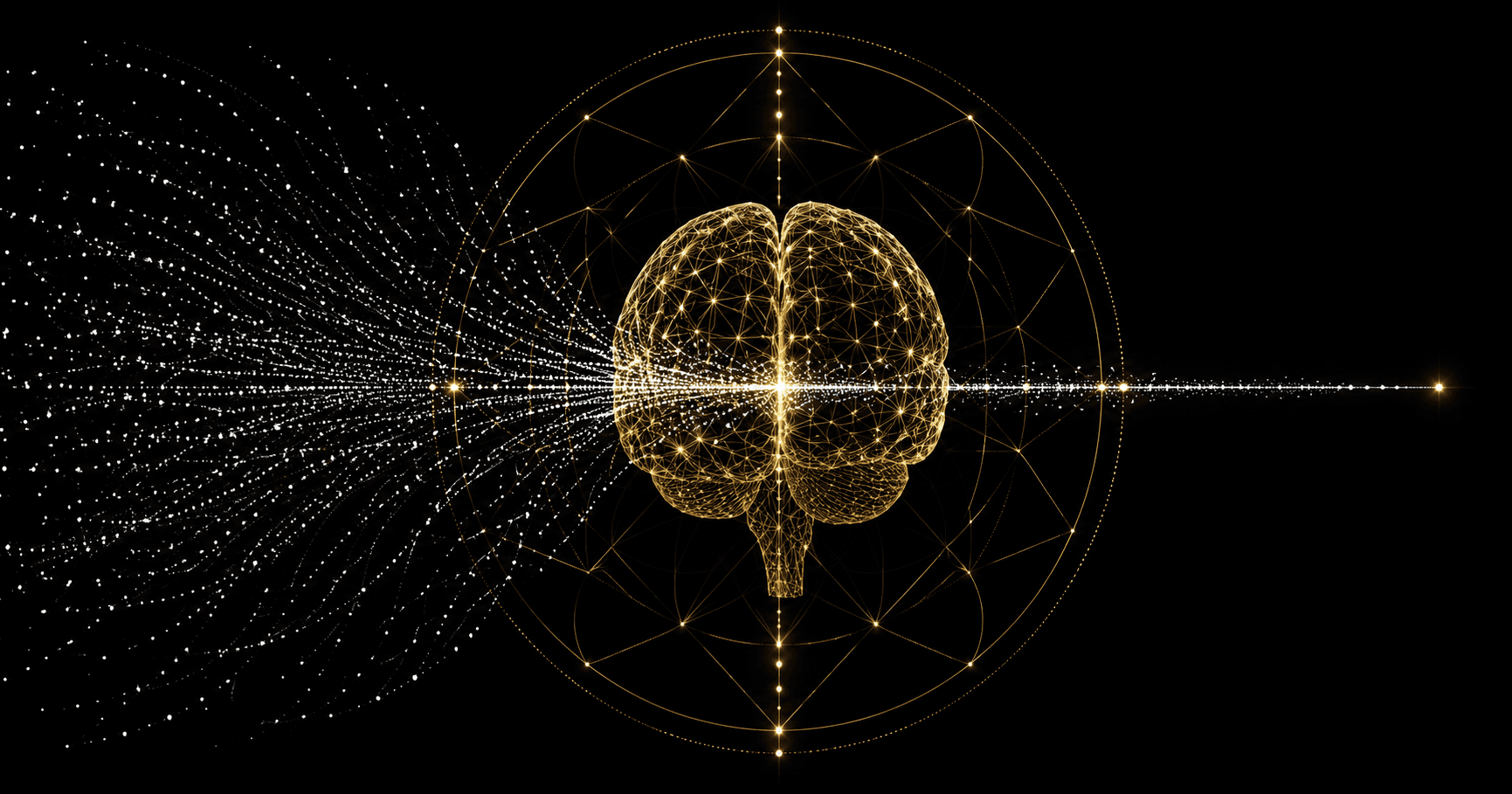
Right now, your senses are taking in roughly 11 million bits of information per second [1]. Your conscious mind processes about 50.
That means 99.9995% of reality is being deleted before you ever see it.
The thing doing the deleting is a real, physical structure in your brainstem called the Reticular Activating System (RAS). It's a network of neurons that acts as your brain's gatekeeper. It decides what gets through to conscious awareness and what gets filed as background noise [2].
Damage the RAS and you fall into a coma. Suppress it with anaesthesia and you lose consciousness. It's not a metaphor. It's the literal mechanism that keeps you awake, aware, and paying attention to specific things while ignoring everything else.
And you've never once configured it on purpose.
The filter you didn't set
You've experienced the RAS without knowing its name. Learn a new word and you hear it three times that week. Consider buying a specific car and suddenly it's everywhere. Start thinking about having kids and every second person on the street is pushing a pram.
The world didn't change. Your filter did.
Psychologists call this the Baader-Meinhof phenomenon, or frequency illusion [3]. It feels like a coincidence. It's not. Your RAS was primed with a new category, and now it's flagging matches from the millions of data points it was previously discarding.
This is the same mechanism behind confirmation bias. Once you believe something, your RAS starts filtering for evidence that confirms it and deprioritising evidence that contradicts it. You don't decide to ignore counterevidence. Your brain does it before the information reaches you [4].
Everyone is programming your filter. Except you.
Here's where it gets uncomfortable.
The RAS responds to priming, framing, repetition, emotional arousal, and identity statements. These aren't obscure techniques. They're the basic toolkit of every advertiser, politician, cult leader, and algorithm designer on the planet.
Priming. Mention something and people start noticing it. "Have you noticed how often Dave interrupts?" Now they can't unsee it. You didn't change Dave's behaviour. You changed their filter.
Framing. "Experienced professional" vs "overqualified candidate." Same person, same CV, same skills. Completely different filter installed by two words.
Repetition. The RAS prioritises frequently encountered information [5]. This is why propaganda works not by convincing but by priming. Hear something enough times and your brain starts treating it as background truth, not because you evaluated it, but because frequency signals importance to the RAS.
Emotional arousal. Fear, excitement, desire. The amygdala flags threats and rewards as high priority [6]. Advertisers and news outlets exploit this directly. An emotionally charged message bypasses analytical processing and goes straight into the filter.
Identity framing. "You're the kind of person who..." is the most powerful of all. Once the RAS accepts an identity frame, it filters for confirming evidence 24/7. You don't need to maintain the belief consciously. The filter maintains itself.
Every social media algorithm is programming your RAS without your consent. Every news cycle is installing filters you didn't choose. Every ad is a tiny act of colonisation on your attention.
The first frame wins
The RAS has a strong bias toward the first input it receives on any topic [7]. This is why first impressions are so hard to override. The initial frame becomes the baseline, and the RAS actively reinforces it by flagging confirming evidence and deprioritising contradictions.
Research suggests most people need to encounter a contradiction 10-20 times before it overrides an established anchor [8]. The RAS treats the existing frame as "known safe" and new information as noise.
This is why changing someone's mind feels impossible. You're not arguing against their opinion. You're arguing against a neurological filter that's actively suppressing your evidence before it reaches their conscious awareness.
It's also why it's so hard to change your own mind about yourself. "I'm not good with money" or "I'm not a morning person" or "I'm not creative" aren't conclusions you reached through careful analysis. They're filters you installed once, probably in childhood, and now your RAS confirms them daily.
Programming it yourself
If the RAS is going to be programmed regardless, the question isn't whether to program it. It's whether you do it on purpose or let everyone else do it for you.
The methods are the same ones being used on you. The difference is consent and direction.
Choose your inputs deliberately. What you consume daily is what your RAS treats as important. Curate ruthlessly. Unfollow, unsubscribe, mute. Every input is a vote for what your filter should prioritise.
Use identity statements. Not affirmations. Identity. "I'm a person who writes every day" installs a filter that makes you notice opportunities to write and feel friction when you don't. The RAS doesn't care if the statement is true yet. It starts filtering for confirmation regardless [9].
Prime yourself with questions. The RAS loves open questions. "How could I make this work?" sets it hunting for solutions in the background. "Why does this always happen to me?" sets it hunting for evidence of victimhood. Same mechanism, opposite direction. Choose the question carefully.
Control the first frame. When starting something new, the first narrative you attach to it becomes the RAS default. "This is going to be hard" and "I wonder what I'll discover" lead to completely different filtering on the same experience.
Repetition works on you too. Journalling, reading, conversation. Repeated exposure to an idea doesn't just teach it. It installs it as an RAS filter. You start noticing evidence for it in your daily life. This is why environments matter more than intentions. You can't out-think the thing you're surrounded by.
The uncomfortable implication
This means there's no neutral position. There's no "unfiltered reality" you can access by being rational enough or sceptical enough. You always have a filter running. The only choice is which one.
Robert Anton Wilson called these filters "reality tunnels" [10]. Every ideology, every belief system, every identity is a tunnel. Marxism is a tunnel. Libertarianism is a tunnel. Optimism is a tunnel. Cynicism is a tunnel. You can switch tunnels, widen them, become aware of them. But you can't remove them.
The people who think they have no filter, that they're "just seeing things clearly," are the most captured. They've identified so completely with their tunnel that they can't see the walls.
The goal isn't to escape all tunnels. It's to choose yours deliberately, hold them lightly, and switch when they stop serving you.
That's what this site is about.
References
- Zimmermann, M. (1986). "Neurophysiology of Sensory Systems." In Fundamentals of Sensory Physiology, Springer-Verlag, pp. 68-116.
- Moruzzi, G. & Magoun, H.W. (1949). "Brain stem reticular formation and activation of the EEG." Electroencephalography and Clinical Neurophysiology, 1(4), 455-473.
- Zwicky, A.M. (2006). "Why are we so illuded?" Stanford University Linguistics Department. Originally described as the frequency illusion.
- Nickerson, R.S. (1998). "Confirmation Bias: A Ubiquitous Phenomenon in Many Guises." Review of General Psychology, 2(2), 175-220.
- Zajonc, R.B. (1968). "Attitudinal Effects of Mere Exposure." Journal of Personality and Social Psychology, 9(2), 1-27.
- LeDoux, J.E. (1996). The Emotional Brain: The Mysterious Underpinnings of Emotional Life. Simon & Schuster.
- Tversky, A. & Kahneman, D. (1974). "Judgment under Uncertainty: Heuristics and Biases." Science, 185(4157), 1124-1131.
- Anderson, C.A., Lepper, M.R. & Ross, L. (1980). "Perseverance of Social Theories: The Role of Explanation in the Persistence of Discredited Information." Journal of Personality and Social Psychology, 39(6), 1037-1049.
- Oyserman, D., Smith, G.C. & Elmore, K. (2014). "Identity-Based Motivation: Implications for Health and Health Disparities." Journal of Social Issues, 70(2), 206-225.
- Wilson, R.A. (1983). Prometheus Rising. New Falcon Publications.